Blog
Blog posts
The Terrible Stroad: Road of Compromises
The post advocates for purpose-built and opinionated data products, akin to well-designed streets or roads. To avoid becoming a "stroad", the author suggests defining a clear purpose, saying no to feature creep, prioritizing the user experience, and iterating and improving.
You’ve seen them if you’ve spent any time in North America. You likely didn’t know their names.
I sure didn’t.
Not until I watched this video from Not Just Bikes on YouTube.
If you don’t have the time, don’t worry. I’ll summarize:
🚙 Stroads are a street/road hybrid that are dangerous and ineffective.
🚶♀️ Stroads are hostile to non-car users and make walking or cycling uncomfortable and dangerous.
💸 Stroads are expensive to maintain and do not provide good value for the space they take up.
🌳 Stroads are ugly and uninviting due to the removal of trees in their clear zone.
🏢 Stroads do not support a sense of community or encourage people to stay and spend time.
NJB pulled from a fantastic word from Strong Towns – the “Stroad”.
"Stroad" is a word we coined in 2013 to explain those dangerous, multi-laned thoroughfares you encounter in nearly every city, town, and suburb in America. They're what happens when a street (a place where people interact with businesses and residences, and where wealth is produced) gets combined with a road (a high-speed route between productive places).
They are enormously expensive to build and, ultimately, financially unproductive. They're also very dangerous.
Stroads are a compromise – in the worst sense. They are an attempt to have the best of both – interaction vs. transit – without the courage to recognize that these are opposing purposes.
The Compromise Conundrum
Just as the stroad attempts to straddle the line between street and road, data products can fall victim to the same compromise conundrum. When we try to create a product that caters to everyone's needs and desires, we end up with an unwieldy, unfocused mess.
A dashboard that attempts to solve everything. A table meant to summarize and store. An API meant to convey differing levels of granularity.

Instead of producing a data product that's flexible and nimble, we end up with a stroad-like monstrosity, a hodgepodge of features and functionality that's neither efficient nor effective. And just like the stroad, this kind of data product is expensive to build, difficult to maintain, and frustrating to use.
Think of it as a zoom level on a map. The difference between a globe and a topographic map. Both opinionated. Both useful. Yet meant for different purposes. When navigating treacherous terrain, a globe does nothing to forge a safe path ahead. When flying high in the air or navigating oceans, what good is the topography of a trail?
Opinionated Data Products
It's time for data products to take a stand. Rather than striving to be all things to all people, data products should be opinionated. An opinionated data product knows what it wants to achieve and isn't afraid to make bold choices in pursuit of its goals.
An opinionated data product might make some users unhappy by not catering to their every whim. However, by focusing on a clear, specific goal, it provides a better experience for its core audience. Instead of trying to be a stroad that pleases no one, an opinionated data product can be a well-designed street or road that serves its purpose with aplomb.
“When you try to be everything to everyone, you accomplish being nothing to anyone” - Bonnie Gillespie
Anatomy of a Data Product
That leaves us still with the need for structure. You can’t refine a product without first understanding it’s components. Let’s revisit a definition
A data product is a collection of data that is designed to meet the specific needs of a user base, providing a range of interfaces through which users can interact with it. These interfaces may include software, visualizations, direct feeds, and more. Ultimately, a data product serves to fulfill certain tasks or "jobs" that the user base requires, making it a purpose-built solution for meeting specific data-related needs.
The components of a data product should be as follows and give us the flexibility to alter each to support purpose-built solutions. A data product is:
- Adaptable: Seamlessly integrates with various inputs and outputs, and effortlessly expands to accommodate new data sources.
- Specialized: Purposefully designed to address a focused set of valuable problems for external customers.
- Discoverable: Easily found and accessible without being hidden or restricted.
- Fortified: Ensures security and stability for reliable data handling.
- Contextual: Maintains a historical record of its purpose and problem-solving context, including a data dictionary and external references.
- Engaging: Captivates the interest of its target audience through relevant and valuable insights.
- Loveable: Exceeds the minimum loveable product standard, making it approachable and user-friendly.
Embracing Purpose
So, how can you avoid the perils of the stroad when creating your next data product? Here are a few principles to guide you:
- Define a clear purpose: Before you start building your data product, make sure you know exactly what you want it to accomplish. By having a clear purpose, you'll be better able to make focused decisions that serve that goal.
- Say "no" to feature creep: It's tempting to add more and more features to your data product, but this can lead to a stroad-like morass. Stay focused on your core purpose and be willing to say "no" to features that don't align with it.
- Prioritize the user experience: Just like the stroad is an unpleasant place to be, a poorly designed data product can be a frustrating experience for users. Keep your users front and center in your design process, ensuring that your data product is easy to use and meets their needs.
- Iterate and improve: Don't be afraid to make bold choices in your data product. If something isn't working, learn from the feedback and iterate on your design. This iterative process will help you hone in on the perfect balance between form and function.
By embracing these principles and avoiding the trap of the stroad, you can create data products that are focused, efficient, and effective. Remember, it's better to be a great street or a great road than a terrible stroad.

How to Build Data Products that Solve Real-World Problems
Are you looking to build data products that can make a real-world impact? As a product leader with years of experience building successful data products, I know that it takes more than just technical know-how to create a product that truly solves a problem. In my latest blog post on kevintholland.co
Greetings, my fellow data enthusiasts!
Today, we're going to talk about how to build data products that don't just look pretty on a dashboard but actually solve real-world problems. As a product leader at Holmusk and a builder of 0-1 health data products, I've had my fair share of successes and failures in this space.
“Build it and they will come” right?!- hate to break it to you but this ain’t no field of dreams. It has to be one of realities.

Ask the right questions, put together the right team, build with the right thinking, experiment and iterate with the right vision. With that, you'll get somewhere great.

So, let's dive into the steps you need to take to create data products that make a difference.
Step 1: Define the problem
Before you even think about gathering data or building a model, you need to define the problem you're trying to solve. What's the pain point for your target audience? What's the impact of not solving this problem? Who are the stakeholders involved? You need to have a clear understanding of the problem you're solving before you can even start thinking about how to solve it with data.
Step 2: Gather the right data
Now that you've defined the problem, it's time to gather the data that will help you solve it. You need to gather data that's relevant to the problem you're trying to solve. This can come from a variety of sources, including public datasets, internal databases, and user-generated data. You also need to ensure that the data you're gathering is of high quality, accurate, and complete. Garbage in, garbage out, as they say.
Step 3: Clean and prepare the data
Now that you have the data, it's time to clean and prepare it. This can be a time-consuming process, but it's essential if you want your data product to be accurate and reliable. ETL is critical for lineage, documentation, and merging and all of the other governance components needed. A skilled data engineer is worth their weight in gold here.
Step 4: Analyze the data
Once you've cleaned and prepared the data, it's time to analyze it. This is where you'll start building your models and algorithms to help solve the problem you've defined. You need to choose the right analytical techniques for the problem you're solving, and you need to ensure that your models are accurate and reliable.
Step 5: Communicate the insights
Now that you have your insights, it's time to communicate them to your stakeholders. This can be a challenging step, as not everyone is familiar with data and analytics. You need to present your insights in a way that's easy to understand and actionable. This could mean creating visualizations, dashboards, or reports that are tailored to your audience. Build with the end (and ideal customer profile (ICP)) in mind.
Step 6: Test and iterate
Building a data product is not a one-and-done process. You need to test your product and iterate based on feedback from your stakeholders. This means going back to step 1 and refining your problem definition, gathering more data, or changing your analytical techniques. The key is to stay agile and be willing to pivot when needed.
Step 7: Monitor and maintain
Once you've built your data product, it's essential to monitor and maintain it. This means ensuring that the data you're using is up-to-date and accurate. You also need to monitor your models and algorithms to ensure that they're still providing the insights you need. Finally, you need to ensure that your product is secure and compliant with any regulatory requirements.
The same but different
Before we wrap up, let's talk about how data product management differs from traditional software product management. While there are many similarities, such as defining the problem and iterating based on user feedback, there are also some key differences.
First and foremost, data products are inherently more complex than traditional software products. They require a deep understanding of data science, machine learning, and statistical analysis. This means that data product managers need to have a strong technical background and be able to communicate complex concepts to both technical and non-technical stakeholders.
Secondly, data products are often more experimental than traditional software products. You're dealing with data that's constantly changing and evolving, and you need to be able to adapt your models and algorithms quickly. This means that data product managers need to be comfortable with ambiguity and be able to pivot quickly when needed.
Finally, data products require a different kind of team than traditional software products. You need data engineers, data scientists, and analysts who can work together to build, analyze, and communicate insights from the data. This requires a strong focus on collaboration and cross-functional teamwork.
So, if you're building a data product, make sure you have the right team in place. This means hiring people with a strong technical background in data science and analytics, as well as people with strong communication and collaboration skills.
Conclusion
In conclusion, building data products that solve real-world problems is a challenging but rewarding process. By following the steps outlined above and building the right team, you can create data products that make a difference in people's lives. So, go forth and build great data products!
What is a data product?
What is a data product? Ultimately, a data product serves to fulfill certain tasks or "jobs" that the user base requires, making it a purpose-built solution for meeting specific data-related needs.
I've heard this question dozens of times this past year. More when I gave myself the title "Head of Data Products" three years ago at a marketing agency.
Well, just like a product is a collection of software developed for the express purpose of use by a group of users on a continuous basis to satisfy a job they need to accomplish, data products do the same. The added layer of complexity of data is the key and why we are here.
Software as a Service (SaaS) products have the luxury of decades of development and inherently are unopinionated outside of the process. They focus on the "how" and the "what" but rarely the "why". Data necessitates a "why" and the context this carries.
Boiling this down into a useful definition might be this below:
A data product is a collection of data that is designed to meet the specific needs of a user base, providing a range of interfaces through which users can interact with it. These interfaces may include software, visualizations, direct feeds, and more. Ultimately, a data product serves to fulfill certain tasks or "jobs" that the user base requires, making it a purpose-built solution for meeting specific data-related needs.
Explain it to me like I'm 10.
A data product is like a special toolbox full of information that helps people get things done. Just like a regular toolbox has different tools for different jobs, a data product has different ways to use the information inside. It might be a computer program, a picture, or something else that helps people understand the information better.
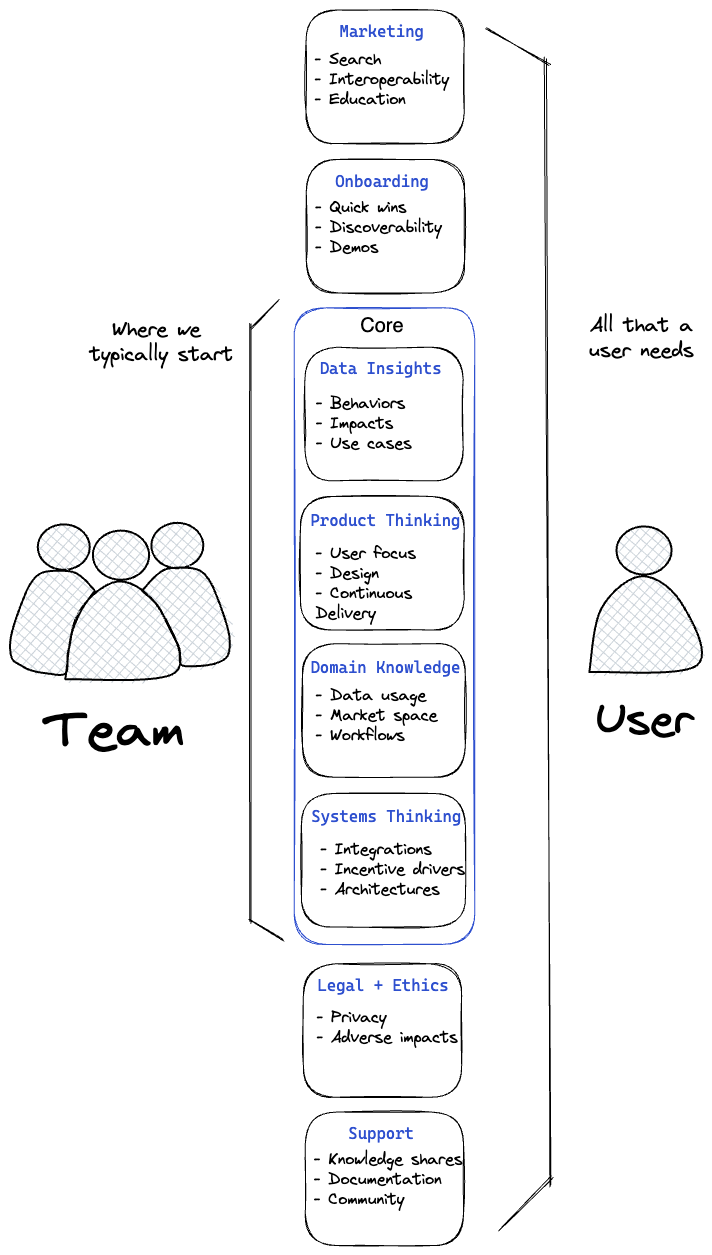
A data product is a product that is created using data insights, domain knowledge, product thinking, and system thinking.
- Data insights: Data insights refer to the knowledge and understanding that is gained from analyzing and interpreting data. This can include insights into customer behavior, market trends, or the performance of a business.
- Domain knowledge: Domain knowledge is the expertise and understanding of a specific industry or field. In the context of a data product, domain knowledge is crucial for understanding the context and relevance of the data being analyzed.
- Product thinking: Product thinking involves designing and developing a product with a specific user in mind. This includes considering the needs and pain points of the user, as well as the features and functionality that will make the product valuable and easy to use.
- System thinking: System thinking involves considering the bigger picture and how all of the pieces of a product fit together. This includes understanding how a product will be used within a larger system, and how it will integrate with other products or processes.
Combining these four elements allows data product teams to create data products that are not only based on accurate and relevant data, but also designed to be useful and valuable to the end user.
By using data insights and domain knowledge to inform product design, and considering both the user and the larger system, organizations can create data products that drive business value and help solve real-world problems.
Is it really that simple?!
Well from the number of obtuse words used above... no. But yes it can be.
An enterprise sales dashboard? A data product.
A direct API to Census.gov? A data product.
A personal budget? A data product.
An SAP instance for a Fortune 10 company? A data product
A family calendar or travel expense planner? A data product.
It's a special toolbox of data and ways to interact with it built to help people to get things done.
Learn More
- How to Create Data Products - Whitepaper from Tableau
- Data as a product vs. data products
- Defining data products
Disclaimer
Please note that the content on this personal blog is intended for educational and informational purposes only. It is not intended to be a substitute for professional advice, including but not limited to financial, legal, or medical advice. The author of this blog is not a licensed professional and does not provide any investment advice.
All the information presented in this blog is based on the author's personal opinions and experiences. The blog may also include references to third-party independent sources, but the author does not guarantee the accuracy or completeness of the information provided by these sources. It is the reader's responsibility to conduct their own research and seek professional advice if necessary.
The author of this blog does not take any responsibility for any loss, injury, or damage that may result from the use of the information provided on this blog. Readers are advised to use their discretion and judgment when applying any of the information provided on this blog.
Hello there, welcome to the crossroads
It's a blog. Here we go!
It's a blog. Yes, those web-log things from days gone by.
When "you've got mail" chimed. Kazaa was a twinkle in the eye of Niklas Sennstrom and pets.com hadn't yet been the butt of the collective joke.
I'm just throwing my hat in the collective ring, during the Web 2.5 era.

So what's this about?
Oh, lots of things. The desire for singular direction and "thought leadership" in the Substack world is tiring to me. The world is a big place and I'm obsessed with systems and synthesizing them.
This space will be mostly about the following:
- Data products and their management
- Systems thinking
- US healthcare (that multi-headed hydra)
- Management and leadership
- Telling impactful stories with data
- Solving world peace (unlikely but it's always good to have "big hairy audacious goals")
Ups and downs, lefts and rights.
A crossroads.
Some added, some removed. A drop in the bucket but it's mine. Create more than you consume.