From BI to AI: How Decision Support Is Changing
From BI to AI, the interface is changing and the data team's responsibility is getting wider: preserve the foundations, add workflow context, and stop when the system cannot support a trustworthy decision.
From BI to AI: How Decision Support Is Changing
Cindi Howson argues that business intelligence is not dead. The label is fading, the interface is moving, and analytics is reaching more people.
When analytics becomes a chat layer, a data team can lose the thing it spent years earning: trust. Understanding, capability, and credibility tend to follow.
That loss matters more than the label.
The foundations did not disappear
Semantic definitions, governance, monitoring, and reusable metrics still do the work underneath the interface. Product thinking still starts with the same sequence. Make it matter, make it work, make it safe and correct, make it scale, then make it a system.
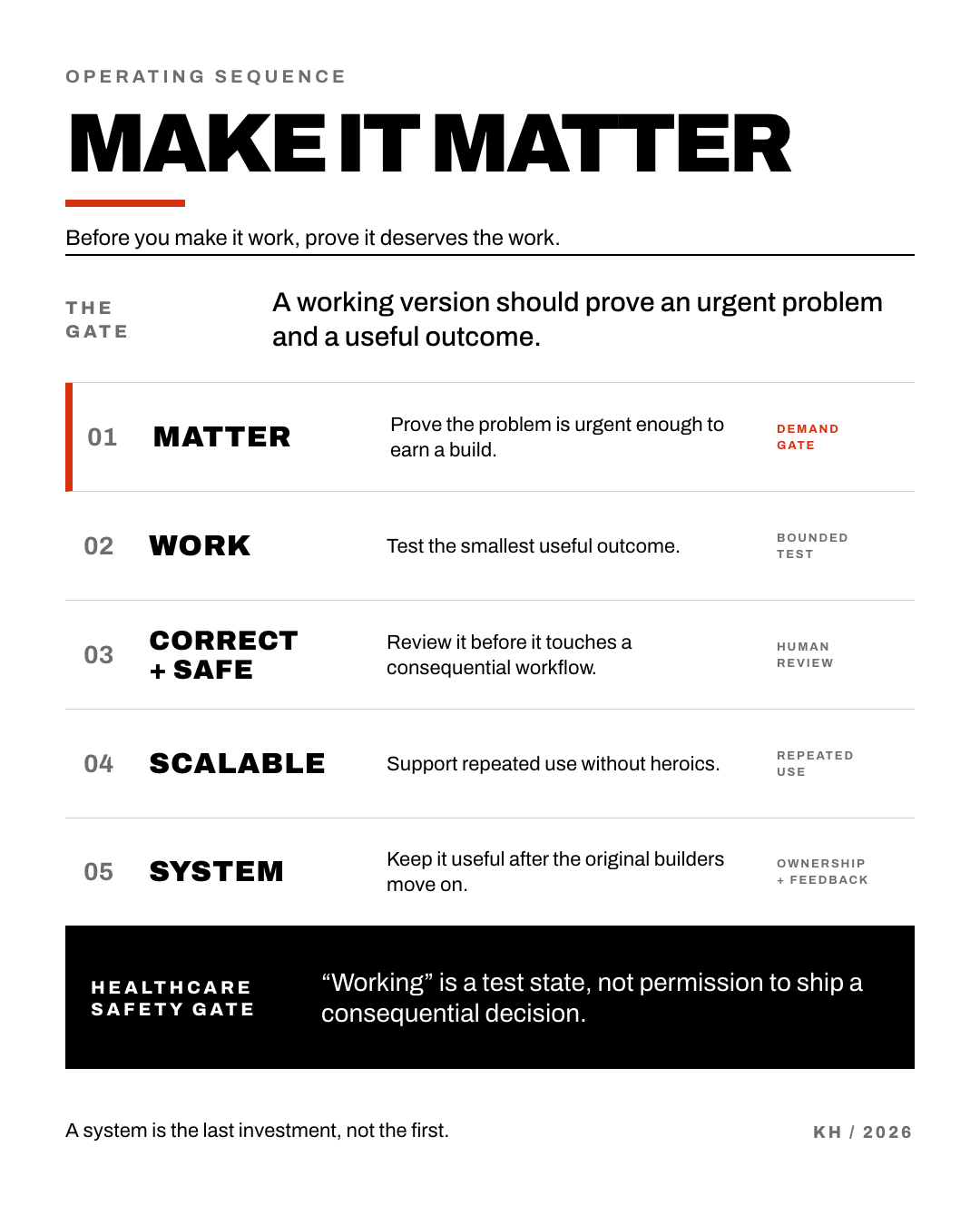
Prove the problem deserves the work before turning the work into a system.
AI changes the route into those foundations. A user can ask a question inside a workflow instead of opening a dashboard. The input may be a natural-language question, an incomplete description, or context from a conversation. The output still needs a boundary that someone can inspect, challenge, and use.
That is the difference between a useful assistant and a fluent answer.
Anthropic's data team makes the opportunity and the constraint unusually clear. Its self-service analytics write-up warns that pointing an agent at a warehouse can create false precision. Anthropic's response was to narrow ambiguity with canonical datasets, human-owned definitions, documented analyst workflows, evaluations, provenance, and explicit review for leadership-bound work.
The chat interface widened access. People still had to make the business legible to the system.
A warehouse is not a decision
Access to a CRM or data warehouse is one ingredient in a decision. It is not the decision itself.
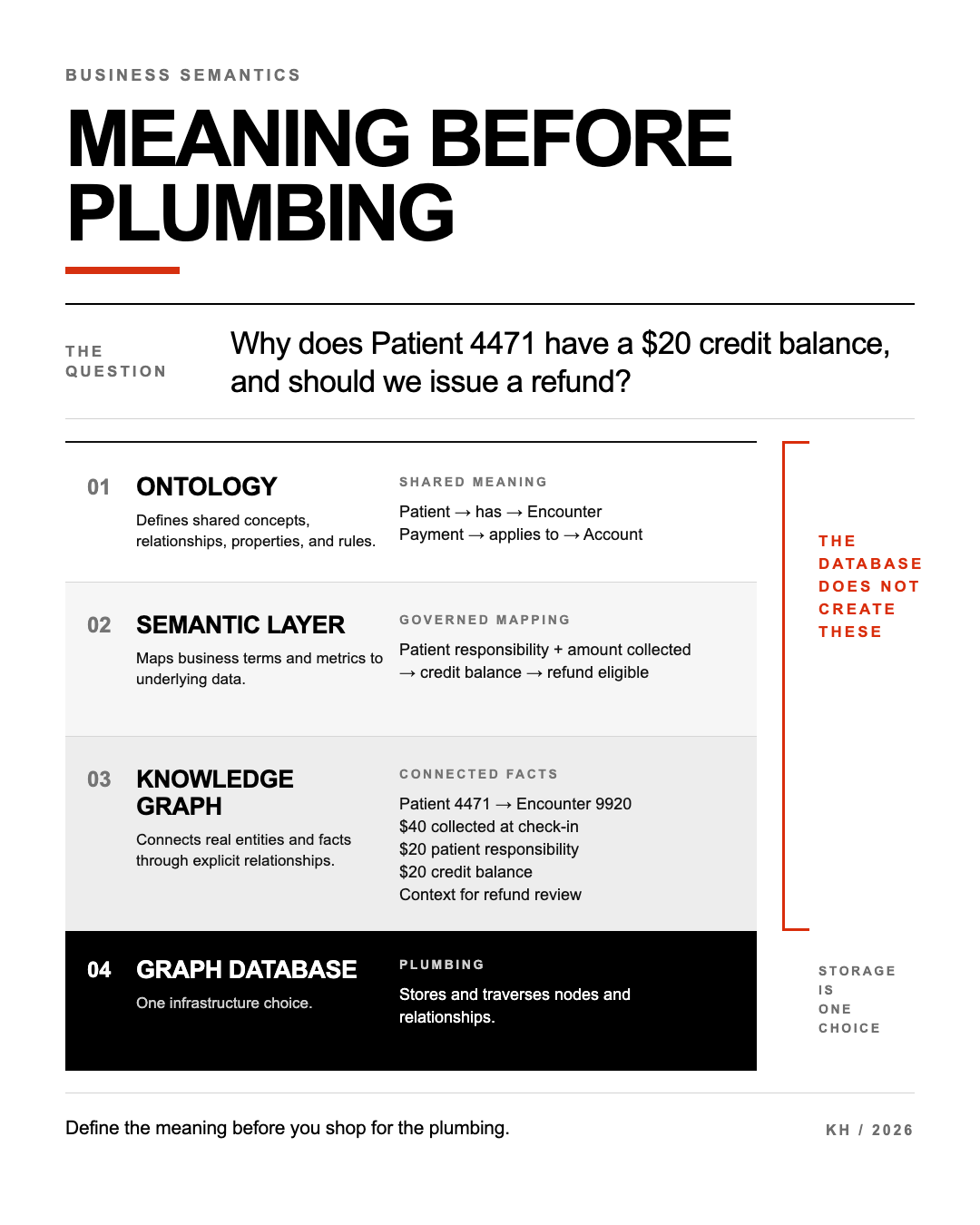
People also use conversations, context, other people, a knowledge base, and the math. Healthcare makes the gap hard to ignore because clinical and operational data is layered, messy, and full of meaning that does not sit in one clean field.
Consider a revenue-cycle leader asking why denials rose. A query can count denial records. A useful answer also needs to know which status is authoritative, whether resubmitted claims count, what changed in coding or payer mix, and who can act on the finding. Those choices live across definitions, workflow knowledge, and human judgment.
A dashboard can show what happened and still leave the user with a “so what?” problem. The data team's job is not to answer every question on a person's behalf. It is to help construct a decision that the owner can understand, review, and carry into the work.
The new interface needs a stop condition
An analytics agent can accept a broader set of inputs and work closer to the decision moment. That also gives it more ways to be wrong.
The system should stop when it does not know what needs to happen or when the context is missing. It should surface the gap and hand the decision to the person who owns it.
That handoff is not a failure of automation. It is part of a trustworthy workflow.
The useful pattern is a flexible input with a fixed review boundary. A person can ask the question loosely. The system must use named definitions, show its evidence, stop when context is missing, and require an accountable reviewer before a consequential action.
The products are rebuilding the analyst's work
The leading analytics products are arriving at the same constraint from different directions.
Microsoft tells Power BI teams to prepare the semantic model and train users to challenge Copilot's output because a plausible response can still be wrong. Snowflake uses human-verified questions and SQL to improve nearby answers. Google separates governed LookML definitions from the user's role, goal, and decision context. Lyft gives important metrics business and operational owners so definitions and data health remain maintained as the metric travels into dashboards, applications, and AI tools.
Together, these systems encode work a senior analyst already performs: resolve the definition, inspect the source, test the answer, expose what is missing, and know who owns the decision.
What data teams need to own
The move from BI to AI changes the interface and broadens the inputs. It does not remove the data team's responsibility for decision support.
When evaluating an analytics agent, ask:
- Which decision sits inside the workflow?
- What definitions and rules does the system use?
- What context can it see, and what is missing?
- Where does the system stop?
- Who reviews the output and owns the action?
These are product questions as much as data questions. They determine whether the output earns trust, or adds another answer that someone has to interpret.
BI did not disappear. Its responsibility got wider. The interface can become conversational and the inputs can become messier. The standard remains. Make the decision understandable, reviewable, and owned by the people who carry it.
For the source frame, see Cindi Howson's “Is BI Dead?”.